

Packing list for a road trip in the Dominican Republic
Exploring the Dominican Republic by car is synonymous with absolute freedom. From the wild beaches of the Samaná Peninsula to the cool mountain roads of Jarabacoa, having your own vehicle allows you to get off the beaten path. However, a successful road trip in the Caribbean doesn't just happen by accident.
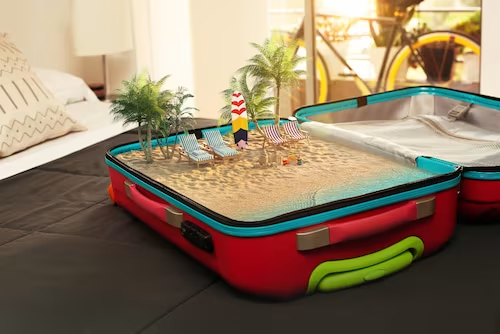
What should you pack for a trip to the Dominican Republic? That’s the question every traveler asks before departure. Between administrative documents, clothing suitable for the tropical climate, and safety equipment, here is your ultimate guide. Use this complete travel checklist for the DR so you don't forget anything.
1. Essential documents for the Dominican Republic
2. What clothes to pack for the Dominican Republic?
3. Shoes and accessories for the Dominican Republic
4. Health and sun protection: Traveling peacefully in the tropics
5. Electronic and digital devices
6. Dominican Republic packing checklist: Dry vs. rainy season
7. Gifts and souvenirs: What to bring back from the Dominican Republic?
1. Essential documents for the Dominican Republic
Before even zipping up your suitcase, make sure your "administrative suitcase" is in order. The Dominican Republic has its own specificities regarding rentals and entry into the territory.
↳ The e-ticket (immigration)
Since 2021, a unique electronic form (e-ticket) is mandatory for entry and exit from the country. It generates a QR code that you must present at the airport.
↳ Driver's license: National vs. international requirements
The rule: For most tourists (French, Belgian, Canadian, Swiss), your valid national driver's license is sufficient for a period of 90 days.
Jumbo Car Tip: Although not mandatory, an international driving permit is extra security in case of a check, as it translates your information. Just make sure your original license is in good condition and legible.
↳ What insurance documents to keep in the car
When picking up the keys at Jumbo Car, you will receive a folder containing:
The rental agreement: essential in case of a check by DIGESETT (traffic police).
Insurance: We strongly recommend full coverage to avoid any deductible. For more details, see our article on travel insurance for the DR.
↳ Emergency contacts and roadside assistance: Your safety net
In the Dominican Republic, the assistance system is very structured to protect tourists. Knowing who to call can turn a stressful situation into a simple travel anecdote.
911: General emergencies
The 911 service works in large urban and tourist areas. It centralizes police, fire, and ambulance services. Use it only in case of personal injury or immediate need for medical assistance.
COMIPOL (Asistencia Vial): The road’s guardian angels
This is the most valuable service for a road trip driver. The COMIPOL (Military and Police Commission of the Ministry of Public Works) patrols 24/7 on the country's major routes.
Their appearance: You will recognize them by their highly visible blue and yellow pick-ups, often parked at strategic points on highways (Autopista Duarte, Las Américas, Autovía del Este, etc.).
Unique number: 809-412-0022. Save it to your contacts right now.
Free services: They intervene at no cost for:
Tire changes: If you get a flat on the highway.
Running out of gas: They provide enough fuel to reach the nearest station.
Mechanical problems: Jump-start assistance (jumper cables) or quick diagnostics.
Towing: If the vehicle cannot be driven, they secure the area and call a tow truck.
Safety: If you need to stop at night, they can park behind you with their flashing lights to protect you from traffic.
Jumbo Car private assistance
In addition to COMIPOL, Jumbo Car offers dedicated assistance for everything specifically related to your rental contract.
24/7 assistance: A direct number is provided when you pick up the vehicle.
Replacement vehicle: In case of a breakdown that cannot be repaired on the spot, Jumbo Car organizes the delivery of a new vehicle so you can continue your vacation without interruption.
Claims management: In case of theft or accident, our agents guide you through local administrative procedures (police report, accident report).
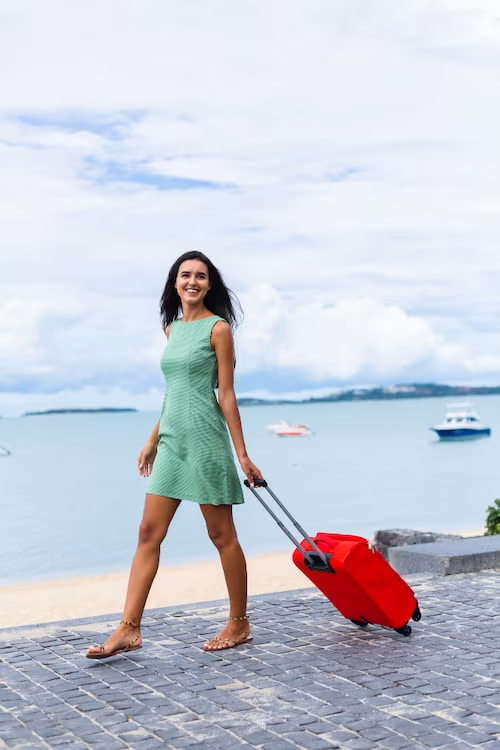
2. What clothes to pack for the Dominican Republic?
The climate is tropical, but depending on your itinerary, your needs will vary.
Light and breathable: Prioritize cotton and linen. Pack t-shirts, tank tops, and shorts for days on the road and at the beach.
Evening wear: Some restaurants and hotels require "smart casual" attire (light pants for men, a dress for women).
For the mountains (Jarabacoa, Constanza): Nights can be cool (60°F / 15°C). A light sweater or jacket is essential.
Swimsuits: Pack at least two so you can alternate while one is drying.
3. Shoes and accessories for the Dominican Republic
↳ Essential shoes
Flip-flops / sandals: For the beach and short trips.
Comfortable sneakers: For city tours or light walking.
Hiking shoes: Essential if you plan to climb Pico Duarte or visit the Samaná waterfalls.
↳ Essential accessories
Sunglasses and hat: The sun is strong, especially while driving.
Dry bag: Very useful for protecting your documents and phones during boat excursions or near waterfalls.
Beach bag and beach towels !
4. Health and sun protection: Traveling peacefully in the tropics
↳ A small kit for peace of mind
A small first-aid kit ( a basic first aid kit ) can be a lifesaver. Include pain relievers, motion sickness tablets (the mountain roads are winding!), allergy medication, and anti-diarrheal pills—because no one wants to be stuck in a hotel room when paradise is just a stone's throw away. If you take prescription medication, pack enough for the duration of your stay, along with a copy of your prescription.
↳ Sun protection
Use reef-safe sunscreen. The marine ecosystems of Bayahibe and Samaná are fragile.
Pro tip: Pharmacies in the Dominican Republic are well-stocked, but if you are looking for a specific brand, you might not find it. Bring your essential medications.
5. Electronic and digital devices
Smartphone & GPS: Download offline maps on Waze or Google Maps. Waze is extremely accurate in the DR for reporting "policias acostados" (speed bumps).
Power adapter: Outlets are type A and B (like in the USA/Canada, 110V).
Power bank: So you never run out of battery during your long trips.
↳ Auto accessories with Jumbo Car
To optimize your comfort, we offer specific options when you book:
Baby seat and booster: Your children's safety is paramount, especially on winding roads.
Integrated GPS: If you prefer not to rely on your phone.
Paso rápido: Ask if your vehicle is equipped with the toll pass badge to avoid lines toward Punta Cana or Samaná.
↳ What NOT to pack (common mistakes)
Too much foreign currency cash: Exchange some money into Pesos (DOP) for tolls and small shops. Dollars and Euros are accepted but often at unfavorable rates.
Clothes that are too heavy: Even in the mountains in Jarabacoa, a light sweater is enough in the evening.
Visible valuables: Never leave a laptop or jewelry in plain sight on the car seats during your beach stops.
↳ Road-Tripper testimonials
"We rented an SUV to tour the Samaná Peninsula. Following Jumbo Car's tips on the e-ticket and tire checks saved us a lot of time. Freedom is absolute!" — Marc & Sophie, Lyon.
"The Paso Rápido badge is a must-have! We saved at least an hour on the Santo Domingo - Punta Cana trip. And above all, download Waze, it's the reigning app here." — Julien, Montreal.
6. Dominican Republic packing checklist: Dry vs. rainy season
Category | Dry season (Dec - Apr) | Rainy season (May - Nov) |
Clothes | Light cottons, linen | Quick-dry clothing |
Rain | A light windbreaker | Lightweight rain jacket / Umbrella |
Protection | High SPF Sunscreen | Strong mosquito repellent |
Misc | Sun hat | Sturdy dry bags |
7. Gifts and souvenirs: What to bring back from the Dominican Republic?
Thanks to your spacious trunk with Jumbo Car, you can bring back:
Dominican rum: Barceló or Brugal.
Coffee and cocoa: Jarabacoa's production is excellent.
Larimar or amber: Semi-precious stones typical of the island.
↳ What is the list of things not to forget for vacation?
Never forget your original driver's license, your passport, your E-ticket, and a credit card for the car rental deposit.
↳ What is the 5-4-3-2-1 packing rule?
It's a golden rule for traveling light: 5 tops, 4 bottoms (shorts/pants), 3 accessories (hat, glasses, bag), 2 pairs of shoes, and 1 swimsuit (though in the DR, we recommend 2!).
↳ What should I pack for a trip to the Dominican Republic?
In addition to clothes, bring mosquito repellent, biodegradable sunscreen, and a US-style power adapter.
↳ Punta Cana packing list?
For Punta Cana, pack beachwear, evening attire for all-inclusive resorts, and don't forget your mask and snorkel if you rent a car to visit quieter beaches like Playa Macao.
Ready to hit the road? Check out our practical guide for renting a car in the DR and book your vehicle today.
