

Driving customs in the Dominican Republic
Renting a car is, without a doubt, the best way to explore the island with total freedom, from the lively shores of Punta Cana to the mountains of Jarabacoa. However, for any traveler, getting informed about the local driving customs in the Dominican Republic is an indispensable step before getting behind the wheel. While the theoretical rules of the international road code apply, daily practice responds to very specific cultural codes.
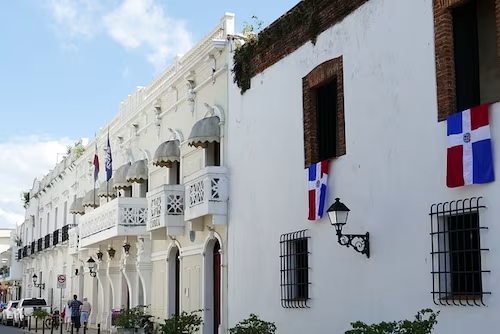
For travelers, understanding how to drive in the Dominican Republic and grasping local traffic can sometimes seem confusing at first glance. Don't panic: it is not a lack of rules, but rather a set of informal road traditions adopted by local drivers.
🚗 Ready to explore the island with complete freedom? Book your ideal vehicle with Jumbo Car right now and enjoy our exclusive rates for summer 2026.
To guarantee a smooth road trip, mastering the art of driving in the Dominican Republic is essential. Here are the 5 major customs to integrate before starting your journey.
1. Headlight flashing and optical signals: A two-way code 🗺️
When studying driving customs, headlight language is often the first element that surprises foreign drivers. In Europe or North America, flashing your headlights usually means that someone is yielding the right-of-way to you. On Dominican roads, the meaning is quite often reversed.
↳ Flashing headlights to claim right-of-way
When you arrive at an intersection or when a vehicle is about to merge, if the driver opposite flashes their headlights at you, it means: "Watch out, I am passing, do not cut across my path." It is a polite but firm way to signal their presence and claim the right-of-way. This is one of the major subtleties to master when learning how to drive in the Dominican Republic without any trouble.
↳ Hazard lights (warnings) in free-flowing traffic
It is very common to see Dominican drivers activate their hazard lights even when their vehicle is not broken down. This custom is used to:
Signal a sudden slowdown or an unexpected obstacle (pothole, speed bump).
Indicate that the vehicle is crossing a complex intersection straight ahead.
Warn that they are about to make an unexpected maneuver.
2. "Policías acostados": The invisible yet formidable speed bumps 🚧
Another particularity of driving customs lies in how road obstacles are managed. The Spanish term policías acostados translates literally to "lying policemen." These are the speed bumps and humps that dot the country's roads, particularly at the entrance and exit of villages (pueblos).
↳ Why they demand constant vigilance
Unlike international standards, many of these speed bumps are not indicated by road signs and have no ground markings. They blend perfectly into the color of the asphalt, which complicates the practice of driving in the Dominican Republic.
↳ Local driving technique
Custom dictates that drivers slow down very abruptly as soon as they spot a policía acostado. This is where the ground clearance of an SUV from Jumbo Car makes perfect sense: it prevents damage to the underbody if you cross one at a slightly too high speed.
3. Two-wheeled vehicles: Kings of urban evasion 🏍️
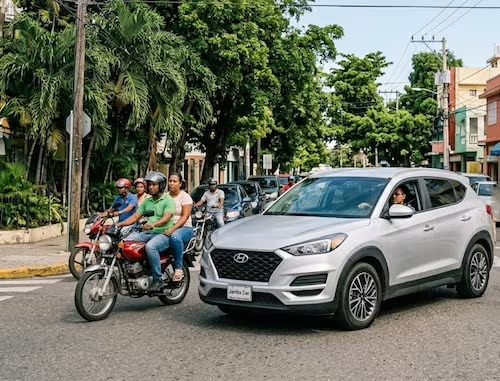
In the global analysis of driving customs in the Dominican Republic, the behavior of two-wheelers plays a central role. The motoconcho (motorcycle taxi) and motorcycles in general are the most popular means of transportation in the country and dictate a large part of the urban traffic rhythm.
↳ Passing on the right and infiltration
Motorcycles customarily filter into the smallest gaps. Expect to be passed indifferently on the left or on the right, even at a red light or in a sharp turn. Knowing how to handle this cohabitation is a golden rule for anyone wishing to learn how to drive in the Dominican Republic.
↳ The golden rule: Systematic use of mirrors
Before every lane change or turn, check your blind spots three times. Dominican motorcyclists are extremely agile, but their trajectory can surprise foreign drivers discovering the experience of driving in the Dominican Republic.
4. The Dominican horn: A friendly communication tool 📢
While the horn is perceived as an aggression or a sign of anger in many Western countries, here it is an essential and mostly friendly communication tool, fully integrated into the driving customs in the Dominican Republic.
↳ A presence indicator rather than an insult
A Dominican uses their horn to say "I am here." You will hear short, brief honks in the following situations:
To warn you that a motorcycle is in your blind spot while you are backing up.
To signal to you that a vehicle is about to pass you on the highway.
To thank a driver who facilitated a maneuver.
5. Intersection management: The first-in, first-passed rule 🔄
At intersections not regulated by traffic lights, driving customs in the Dominican Republic sometimes diverge from strict legal frameworks. Right-of-way yields to the custom of "first engaged, first passed."
↳ The importance of eye contact
Fluidity at intersections relies on visual negotiation. Drivers progressively edge the nose of their vehicle forward to signal their intention to pass. If you hesitate too long, other users will assume you are yielding to them. Stay courteous, predictable, and move forward with confidence to master the art of driving in the Dominican Republic.
[COMPONENT: MID-ARTICLE CTA BUTTON] ✨ Need a vehicle adapted to Dominican roads? Discover our wide fleet of agile city cars and robust SUVs to drive like a local, in complete safety.
6. Why your choice of vehicle is decisive facing these customs 🚗
To adapt serenely to the driving customs in the Dominican Republic and face road imperfections without stress, choosing your rental vehicle category is strategic.
↳ The advantages of an SUV for Dominican roads
Opting for an SUV (like a Kia Sportage or a Hyundai Tucson) offers three major benefits:
Elevated visibility: Essential for anticipating motorcycle movements and spotting unmapped speed bumps well in advance.
Mechanical robustness: Reinforced suspensions absorb potholes and policías acostados effortlessly.
Driving comfort: Ideal for keeping your cool and maintaining concentration amidst the local dynamism.
↳ When to choose a city car?
If your itinerary is exclusively limited to major highways (like the East Highway linking Santo Domingo to Punta Cana) and modern downtown areas, a compact sedan or an agile city car will be perfectly suited and will make parking maneuvers much easier.
🚗 Take the road with confidence with Jumbo Car
Don't let local specificities hold back your desire for adventure. Our teams brief you upon vehicle delivery so that your experience driving in the Dominican Republic takes place under the best possible conditions.
7. FAQ: Answers to your questions about driving in the DR 💬
↳ What is the driving side in the Dominican Republic?
The driving direction in the Dominican Republic is on the right side of the road, just like in the United States, Canada, or France. The steering wheel is therefore on the left side of the vehicle. Overtaking is done on the left on highways, although in the daily practice of driving customs , you must remain vigilant regarding two-wheelers that sometimes filter through on the right.
↳ What are the local traditions in Punta Cana?
Punta Cana is primarily a beach destination, but it boasts a vibrant culture. Local traditions in Punta Cana include music (merengue and bachata), Creole gastronomy (such as the traditional dish La Bandera), and local crafts. On the road side, the resort area is highly modern, but as soon as you leave Punta Cana to explore the deep backcountry, traditional driving customs in the Dominican Republic (like priority to two-wheelers and policías acostados) immediately resume their rights.
↳ What are the customs and traditions of the Dominican Republic?
The customs and traditions of the Dominican Republic are deeply rooted in hospitality, music, carnival, and religious faith. Dominicans are known for their communicative joy of life and their sense of welcome. On the road, these traditions translate into dynamic driving based on visual communication and the friendly use of the horn to signal one's presence.
↳ Is it safe to drive at night in the Dominican Republic?
It is strongly discouraged to drive at night outside of lit urban areas. Many secondary roads lack ground markings, livestock may cross the roadway, and some users (especially two-wheelers) ride without functioning tail lights. Plan your trips to arrive at your destination before sunset.
↳ How to react during a traffic police control (DIGESETT) in the Dominican Republic?
Routine checks are frequent and aim to ensure safety. If a DIGESETT officer signals you to stop, slow down, park calmly, and remain courteous. Present your valid national driver's license, your passport, and your Jumbo Car rental contract. Seat belts are mandatory, and using a phone while driving is strictly prohibited.
↳What to do in case of a pothole or sudden obstacle on the road in the Dominican Republic?
If you spot a pothole at the last millisecond, do not make a sudden steering correction that could swerve you into the opposite lane or into a motorcycle. Brake firmly while staying in your trajectory. The cars in our fleet are equipped with quality tires to face these unexpected events.
Ready to experience the Dominican adventure?
By keeping these driving customs in the Dominican Republic in mind, you will naturally blend into the flow of local traffic. Enjoy the total freedom offered by a personal car. Rent your vehicle from Jumbo Car and set off to explore the hidden treasures of the island with complete peace of mind.